Cause Matters Blog

Archive for the ‘Articles’ Category

Wheat Farmer: The Data Guy in Kansas

Wednesday, October 20th, 2010

Software developer… or soil?

Darin Grimm didn’t plan on being a farmer.

His passion for technology, data, and business lead to dreams of becoming a software developer. After graduation, he pursued several interests related to technology before realizing that although you can take the boy out of the farm, you can’t quite take the farm out of the boy.

wheat farmer data head

Family is a priority to Darin - and so is feeding a growing population that will double in their lifetime.

“When I started to really think about what I wanted to do with my life, I started thinking about a family,” admits Darin. “It was then that I realized that I never really left the farm. There’s a deep heartfelt desire to be in agriculture. I can’t really explain the ‘why,’ I just do.”

And so Darin farms.

If you followed him around many days, you’d notice that he doesn’t drive tractors that much and wouldn’t fit the classic definition of “farmer” very well. But he does grow wheat, corn, soybeans, and sunflowers – as well as beef cattle – with his father and a partner. And he has combined his love for farming with his love for technology. Known as the “data guy,” he currently tweets and blogs about his operation and the state of agriculture.

Married with four kids, Darin is especially passionate about how to use data and numbers to accomplish specific goals, and enjoys thinking about big issues like how to feed a growing world population with increasingly limited resources. He recently appeared at the World Food Prize to talk with other farmers about this, something he wanted to do because of his involvement with social media through the AgChat Foundation.

Did You Know?

Farming is dirty job in more ways than one. Indeed, farmers spend a lot of time thinking about and taking care of…dirt (they like to call it soil). Farmers like Darin have developed comprehensive nutrient and manure management plans to protect the groundwater leaving their farm. They work on developing knowledge and equipment to reduce tillage in order to improve soil health and decrease erosion. And one of the main reasons he grows corn is because the corn residue keeps the soil from washing and blowing, and provides the building blocks for improving organic matter, a key component of soil health.

farmer and technology

The intersection of farming and technology is where Darin is happiest - and where he sees the most hope for solving hunger.

Consider This…

Studying soil makes good sense, personally and professionally. “I probably have more interest in truly protecting what God gave us than the most outspoken environmentalist,” offers Darin. “I raise my family in this environment, so it’s very personal from that standpoint. And from a business standpoint, crops grow so much more successfully in soil that has been cared for.”

As much as he loves them, Darin doesn’t need data or statistics to understand that his soil (our dirt) is the most important resource he has. While you’re enjoying some crusty bread this Thanksgiving, he hopes you know flour was made from wheat grown on that precious resource. If he could, he’d run a data sample to help you.

You are welcome to use any of our farm stories with full attribution to Michele Payn-Knoper, using the following description (byline): “Michele Payn-Knoper is one of the nation’s leading farm and food advocates. She is a passionate keynote speaker, a trainer known for her energy and a connector for those interested in translating farm to food. Find out more, including the full story of the hands working to bring food to your plate, at http://causematters.com – P.O. Box 92, Lebanon, IN 46052 – 765.427.4426″

Hungry for more farmer stories?
Dairy Farmer: A Californian Goddess
Potato Farmer: Techno Toys in North Dakota
Pumpkin Farmer: All Hands on Deck in Illinois
Cranberry Farmer: A Working Mom in Massachusetts
Turkey Farmer: A Sustainable Entrepreneur in Michigan


Dairy Farmer: A Californian Goddess

Wednesday, October 20th, 2010

Can you imagine keeping 850 ladies happy?

California dairy goddes makes cheese

Barbara Martin stands in her new "Dairy Goddess" cheese room.

Barbara Martin’s life is cows. The California mom lives in the San Joaquin Valley with her husband of 26 years and enjoys shopping, wine tasting, and pedicures, but she LOVES cows. Their farm milks 850 cows and works 365 days a year to provide the milk that goes into the butter on your dinner roll and whipped cream on your pumpkin pie you and your family will be enjoying this Thanksgiving.

With the historically low milk prices of the past two years, Martin and her family have had to get creative in order to keep their business going. In an attempt to gain control over the price they receive for milk, Martin recently scraped together money to begin making cheese under the “Dairy Goddess Cheese” label.

Regardless of the form her business takes, Barbara’s cows are the princesses of the operation. And they are treated accordingly. They have to be — happy cows make lots of milk. Any mother who has breast fed can attest to the fact that milk doesn’t come out if stress is involved. Cows can carry up to 40 pounds of milk in their udder at a time — and they can refuse to release it if they’re upset.

Cheese produced on dairy farm

Cheese, just like milk, is monitored to be sure it's safe for you!

The dairy blood runs deep in Barbara’s family. Her daughter helps with marketing the cheese business and her son is applying for vet school and plans to run his practice on the dairy.

Did You Know?

Soy milk has more estrogen than cow’s milk! Hormones aren’t always the bad guys. The fact is that all food — plant or animal — has hormones since it was once living. In fact, there is more estrogen in cabbage and broccoli than beef. Oh, and all USDA Grade A milk, regardless of label claims, is antibiotic free. It’s tested several times before it hits the grocery store cooler, assuring that it’s safe and nutritious for everyone.

California dairy farmer makes cheese

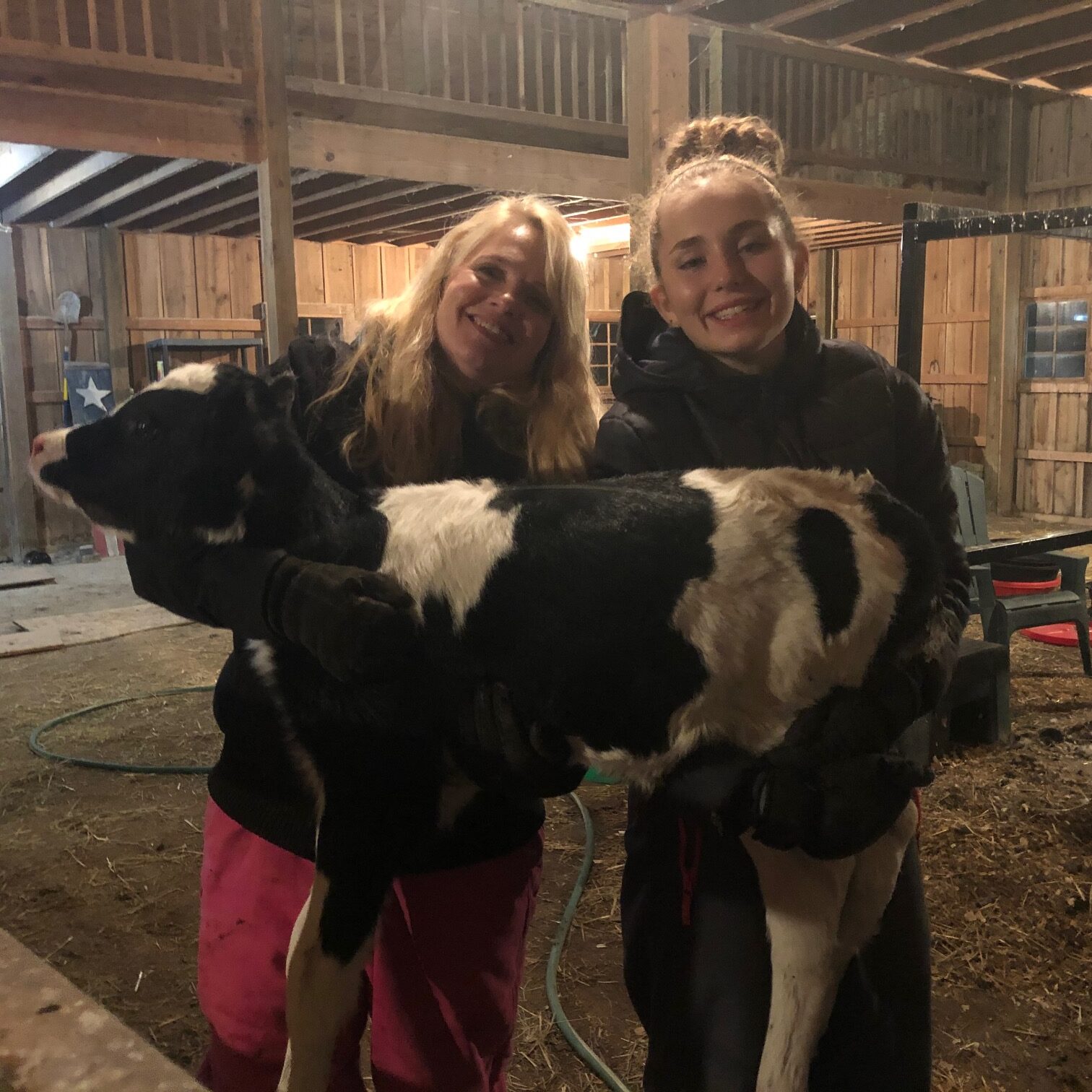
Baby calves receive individual care, similar to a baby nursery, to get a good start in life.

Consider This…

Dairy farmers work with their animals every day — you can’t do that unless you have a deep appreciation for cows. While many people worry about the mistreatment of dairy cows, such behavior doesn’t make much sense from a farmer’s perspective. “My earliest memories growing up are being outside with the cows,” reflects Martin. “Even though I was so very little I had no fear of these big ‘ladies.’ My dad taught us to respect and care for all animals.” Today, Martin spends a lot of time blogging about the moral obligation farmers have to animals. As a businesswoman, she knows that more milk means better business.

And it takes a lot of work to keep 850 cows happy.

You are welcome to use any of our farm stories with full attribution to Michele Payn-Knoper, using the following description (byline): “Michele Payn-Knoper is one of the nation’s leading farm and food advocates. She is a passionate keynote speaker, a trainer known for her energy and a connector for those interested in translating farm to food. Find out more, including the full story of the hands working to bring food to your plate, at http://causematters.com – P.O. Box 92, Lebanon, IN 46052 – 765.427.4426″

Hungry for more farmer stories?
Potato Farmer: Techno Toys in North Dakota
Wheat Farmer: The Data Guy in Kansas
Pumpkin Farmer: All Hands on Deck in Illinois
Cranberry Farmer: A Working Mom in Massachusetts
Turkey Farmer: A Sustainable Entrepreneur in Michigan


Potato Farmer: Techno Toys in North Dakota

Wednesday, October 20th, 2010

When you think high-tech, what comes to mind?

Silicon Valley? Tiny microchips? Fancy smart phones?

How about potatoes?

Most people aren’t thinking technology when digging into their mashed potatoes, but you might be surprised to learn that although spuds are simple, growing them isn’t.

Producers of potatoes on farm

Eric & Gregg Halverson with farm manager, working to grow a healthy potato.

Eric Halverson is the VP of Technology for Black Gold Farms. (Yes, you read that right — VP of Technology.)

And today, technology plays a bigger role than Eric’s family predecessors could have ever imagined. These days, tractors steer by GPS. Special potato storage units are equipped with computer systems that monitor and control everything from temperature, RH, and oxygen levels, allowing farmers to store a better quality product with reduced waste for a longer period of time. New technologies are emerging that can help increase health benefits of potatoes, including adding vitamins and reducing acrylimides.

Black Gold Farms stretches across 11 states but it’s still very much the family farm that started 80 years ago on just 10 acres of land in North Dakota’s Red River Valley.

“We are family owned and operated,” says Halverson, “with the 4th generation highly involved in the daily activities of the farm.” Its family focus allows it to maintain a personal approach to the operation of the farm, while the farm’s size allows it to meet demand for a high-quality product that doesn’t have to be trucked as far. Today, their primary business is providing potatoes that are made into chips for post-feast football games.

Even as technology changes the game, an affinity for potatoes remains constant for the Halverson family.

“It’s in our genes,” says Eric. “Potato farmers are some of the nicest, productive, innovative, environmentally conscious farmers in the world. It takes a certain breed of cat to want to be a potato farmer, and I am proud to be one.”

Technology used by potato farmers

The optical sorter is one of the cool "toys" at Black Gold Farms, sorting potatoes by size.

Did You Know?

Potato farmers have some pretty cool toys. In order to reduce costs and increase quality, they use optical sorting machines, which are able to “look” at the exterior of potatoes and removes the ones that don’t meet their customers’ specific requirements.

Consider This…

Besides being really cool, all this technology serves a very important purpose. Potatoes are the second most consumed food in the United States. By minimizing waste and improving quality, technology helps farmers decrease their carbon footprint, allowing them to raise more food on less land. And not even Apple has an app for that.

You are welcome to use any of our farm stories with full attribution to Michele Payn-Knoper, using the following description (byline): “Michele Payn-Knoper is one of the nation’s leading farm and food advocates. She is a passionate keynote speaker, a trainer known for her energy and a connector for those interested in translating farm to food. Find out more, including the full story of the hands working to bring food to your plate, at http://causematters.com – P.O. Box 92, Lebanon, IN 46052 – 765.427.4426″
Potato farm grows from 10 acres

Today's family farm involves the fourth generation and has grown from the original 10 acres.

Farm to food plate

Harvesting the second most consumed food in the United States.

Moving from plant to food

A healthy potato plant grows in well-cared for soil - treated as "black gold."

Hungry for more farmer stories?
Dairy Farmer: A Californian Goddess
Wheat Farmer: The Data Guy in Kansas
Pumpkin Farmer: All Hands on Deck in Illinois
Cranberry Farmer: A Working Mom in Massachusetts
Turkey Farmer: A Sustainable Entrepreneur in Michigan


Building Bridges in Your Community: 6 Pieces

Friday, June 16th, 2000

The sinking feeling set in as you realized you face the daunting task of building support for your organization within your community. It could be for growing an association’s membership, fundraising, promoting a new event, or even developing a brand. While community relations can be overwhelming, take a step back to consider how you can develop a plan to build a bridge between the community and your ’cause’. In my “Community Connections programs, we discuss 6 critical questions to ask:

  • Who? Determine who your target audience is and identify their hot buttons. Know who you’re trying to reach, prioritize those groups, and then determine what’s important to them by asking questions.
  • What? Develop message to communicate about your organization in a way that’s relevant to the target audience hot buttons. It’s easy to communicate from your perspective, but how about theirs?
  • Why? Understand why your cause should be important to your target audience, then be prepared to communicate that message with power and passion!
  • Where? Brainstorm events and activities where there are opportunities to reach your target audience(s). Strategically approach those events with a plan of action!
  • When? Make a commitment to a timeline for building your bridge and involve other team members to develop their ownership.
  • How? Follow a proven sales process to strengthen the relationship and “sell” your cause. A process I’ve seen work well: build rapport, identify needs by asking questions, offer solution for their needs, motivate to action, overcome objections, and then get their commitment.

Answer these questions and you’ll be on your way to constructing a solid bridge for your organization. Remember… it doesn’t have to be complicated or overwhelming. It’s simply connecting people to a cause that offers tremendous benefit to them and your community!


The “I” in Customer Expectations

Friday, June 16th, 2000

What do your customers expect? Great salespeople find those expectations and meet them as quickly as possible, while mediocre salespeople drone on about their company/product/service without even examining customer expectations.

Do you look at each interaction with your customers as an opportunity to learn? If not, it might be time to think more in terms of diagnosis. The “Selling Power Sales Question Book” offers a wealth of ideas for probing questions:

  • If I had a magic wand and could produce the ideal solution, what would it be?

  • How would you prioritize the features you’re looking for?

  • Considering some of the performance problems you’ve had in the past, what minimum requirements would you expect?

  • What are the compelling factors driving this decision? Is there a deadline?

  • Who else in your organization needs to be briefed on this decision? Should we bring them into the conversation? Do you spend the majority of your pre-call time preparing to “wow ‘em” with your company/product information? Next time you find yourself falling into this trap, slam the brakes on. Spend at least half your prep time thinking of leading questions like those above and you’ll see your sales explode!

    Your goal is to find what the customer is expecting, such as:

  • I need an problem solved!

  • I need service!

  • I need an answer to a question!

  • I need a better value.

  • I need technical assistance.

  • I need to place an order.

  • I need to speak to someone!

  • I need help!Even if they can’t recite the year your company was founded or how many departments you have waiting to serve them, you’ll successfully connect with your customer every time you find a need and meet their expectation.